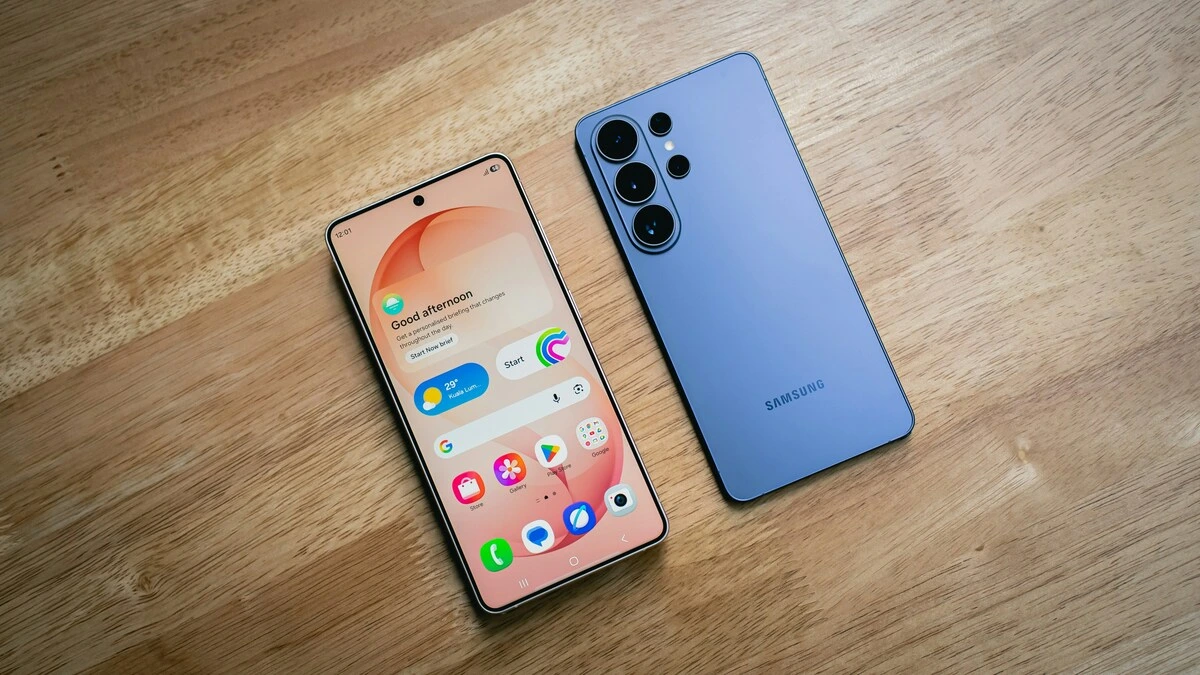

Short answer: Yes, with caveats. The Galaxy S26 Ultra is still the most complete Samsung phone you can buy. It has the fastest Android chip, a bright 6.9-inch screen with a Privacy Display no other phone offers, much faster 60W charging, a built-in S Pen and seven years of updates.
Two things hold it back. The camera hardware has barely moved in three years, and the CPU throttles hard under long loads. It also costs more since Samsung’s October 2026 price rise, now $1,399.99 / £1,360 / €1,550 for the 256GB model.
Buy it if you’ll use the S Pen, the zoom range or Privacy Display. If you won’t, the Galaxy S26+ or a discounted S25 Ultra covers most of the experience for less.
SamScopes Rating: 4 / 5
Updated for One UI 9 and October 2026 prices · Last checked October 10, 2026 · By Stephen Jacob
How this review works: SamScopes doesn’t run its own test lab. Every measured figure on this page (battery runtimes, brightness, charging times, benchmarks, stress tests, camera scores) comes from a named, reputable reviewer, and the source is given next to the number.
Specs come from Samsung. The verdict weighs that evidence against what an S26 Ultra owner actually does with the phone.
Galaxy S26 Ultra review: the verdict at a glance
| Area | Verdict | Key evidence |
|---|---|---|
| Design | Slimmer and easier to hold, but aluminium instead of titanium and a wobbly camera bump | 7.9mm and 214g (Samsung); camera bump rocks on a desk (GSMArena) |
| Display | Still excellent. Privacy Display works, but halves peak brightness when on | 1,480 nits auto, 2,800 nits peak (GSMArena) |
| Performance | Fastest Android phone in benchmarks; throttles under sustained load | Geekbench 6: 3,781 / 11,566 (GSMArena) |
| Cameras | Versatile and dependable, but no longer class-leading | DXOMARK 157 |
| Battery | Good, not great: a full day for most people | 16h 10m (Tom’s Guide); 16:23h Active Use (GSMArena) |
| Charging | Finally competitive | 84% in 30 minutes, full in 43 minutes (GSMArena) |
| S Pen | Still unique, but no Bluetooth or Air Actions | Samsung; Android Authority |
| Software | One UI 9 is rolling out; seven years of updates | Samsung Newsroom |
| Value | Weaker after the October 2026 price rise; promotions help | $1,399.99 list (Samsung US) |
Professional scores sit in the same band as ours: 8/10 from The Verge and WIRED, 4.5/5 from Tom’s Guide and 90% from Notebookcheck.
How much does the Galaxy S26 Ultra cost now?
Samsung raised Galaxy S26 prices in early October 2026, blaming rising memory chip costs (SamMobile). Most S26 Ultra models went up $100, £80 or about €100. The 1TB model went up the most.
| Market (official price) | 12GB / 256GB | 12GB / 512GB | 16GB / 1TB |
|---|---|---|---|
| US at launch (Feb 2026) | $1,299.99 | $1,499.99 | $1,799.99 |
| US since Oct 1, 2026 | $1,399.99 | $1,599.99 | $1,999.99 |
| UK at launch | £1,279 | £1,449 | £1,699 |
| UK since Oct 2026 | £1,360 | £1,530 | £1,860 |
| Eurozone at launch | €1,449 | €1,649 | €1,949 |
| Eurozone since Oct 2026 | €1,550 | €1,750 | €2,150 |
| India at launch | ₹1,39,999 | ₹1,59,999 | ₹1,89,999 |
| India since Sep 23, 2026 | ₹1,54,999 | ₹1,74,999 | ₹2,14,999 |
| UAE at launch | AED 5,099 | AED 5,899 | AED 7,099 |
Sources: Samsung US store, SamMobile, GSMArena and 9to5Google for the October rise. India’s revised prices come from a retail price-revision document reported by 91mobiles, and UAE launch prices from Samsung Gulf’s launch announcement.
Samsung hasn’t announced a UAE price change, but on October 10, 2026 Samsung Gulf’s store listed AED 5,499, AED 6,299 and AED 7,899. Eurozone prices vary slightly by country.
What you’ll actually pay: promotions move these numbers around. When I checked Samsung’s US store on October 10, 2026, all three models were discounted to $1,099.99, $1,299.99 and $1,699.99 (list prices $1,399.99, $1,599.99 and $1,999.99), with the offer marked valid until October 11. Check the store and your carrier before you pay list price.
Every model ships with only a USB-C cable in the box. There’s no charger.
Which configuration? 256GB and 512GB come with 12GB of RAM. Only the 1TB model has 16GB. Our 12GB vs 16GB RAM guide explains why the extra RAM rarely matters, and the storage guide helps you pick a capacity. For most people, 512GB is the sweet spot, because there’s no microSD slot.
Galaxy S26 Ultra specs at a glance
| Spec | Galaxy S26 Ultra |
|---|---|
| Display | 6.9-inch QHD+ Dynamic AMOLED 2X, 1–120Hz, Privacy Display, anti-reflective Gorilla Armor 2 |
| Chip | Snapdragon 8 Elite Gen 5 for Galaxy (all regions) |
| RAM / storage | 12GB + 256GB, 12GB + 512GB, 16GB + 1TB (UFS 4.0, no microSD) |
| Rear cameras | 200MP main (f/1.4), 50MP ultrawide (f/1.9), 50MP 5x telephoto (f/2.9), 10MP 3x telephoto (f/2.4) |
| Front camera | 12MP (f/2.2) |
| Video | Up to 8K30, 4K120, APV codec, Log |
| Battery | 5,000mAh (typical); Samsung claims up to 31 hours of video playback |
| Charging | 60W wired (up to 75% in about 30 minutes, Samsung), 25W wireless, Wireless PowerShare |
| Size and weight | 163.6 × 78.1 × 7.9mm, 214g |
| Build | Armor Aluminum frame, Gorilla Glass Victus 2 back, IP68 |
| Software | Launched on Android 16 / One UI 8.5; One UI 9 (Android 17) rolling out |
| Updates | Seven years of security updates and seven major OS upgrades |
| Colours | Black, White, Cobalt Violet, Sky Blue; Pink Gold and Silver Shadow online only |
Sources: Samsung’s launch spec sheet and Samsung US product page; wireless charging and the back glass from GSMArena. Every number, explained in plain English, is in our full S26 Ultra specs.
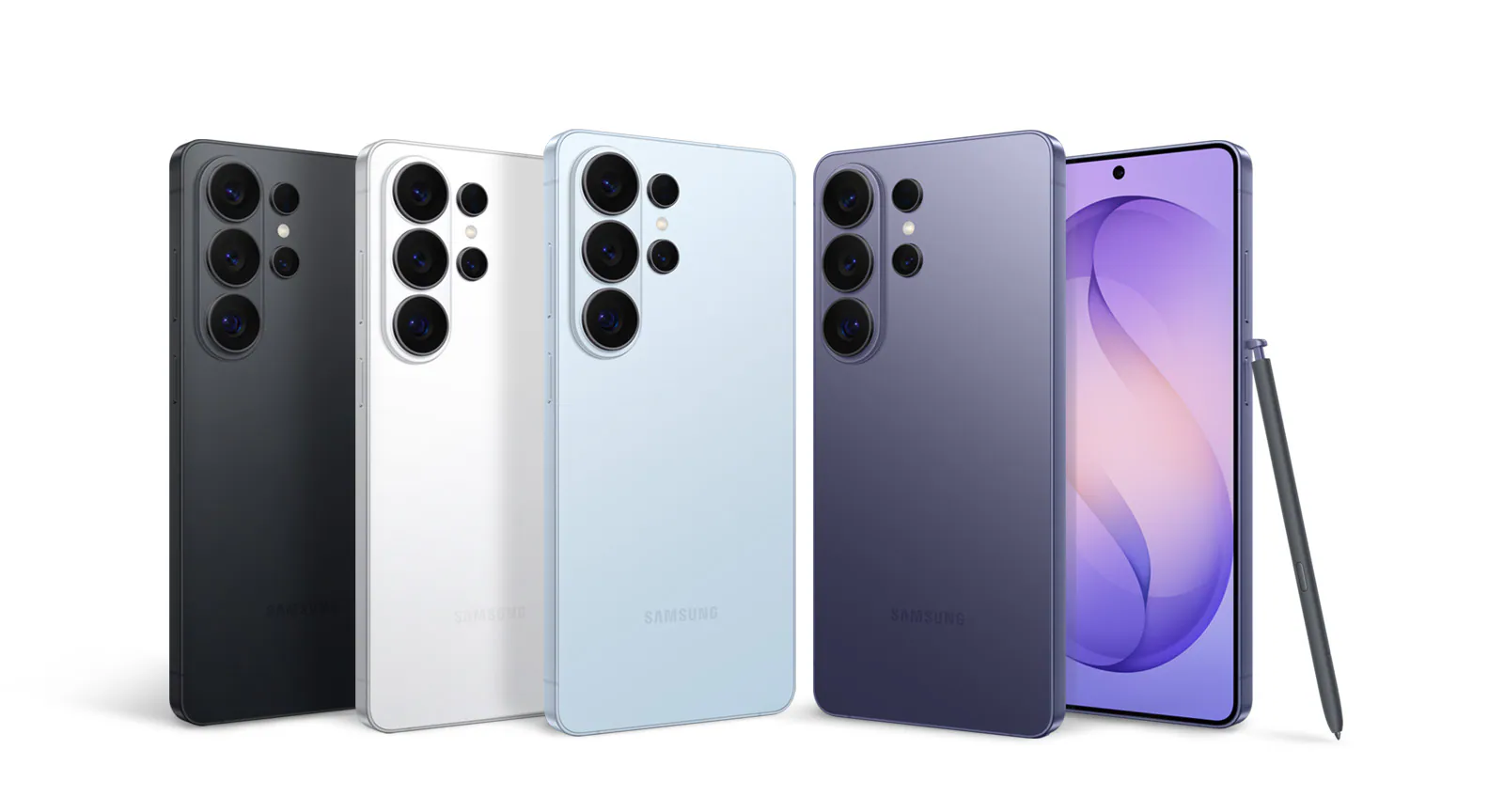
Design and build: slimmer, rounder and back to aluminium
The S26 Ultra looks familiar but feels different. At 7.9mm it’s thinner than the S25 Ultra’s 8.2mm, and the corners are rounder. GSMArena and The Verge both found it easier to hold as a result. It’s still a big, heavy phone, though: 214g and 6.9 inches. Android Authority calls it “very large and hard to use one-handed”.
Three changes are worth knowing about before you buy:
- The frame is aluminium now, not titanium. Samsung uses its Armor Aluminum alloy, after two generations of titanium (S24 and S25 Ultra). GSMArena calls it a downgrade on paper. Android Authority says you won’t feel a difference in the hand, and Ars Technica notes aluminium allows brighter anodised colours like Cobalt Violet.
- The camera bump is taller. All three lens rings stick out further than before, and GSMArena found the phone rocks when you tap it flat on a desk. A case fixes it.
- The S Pen fits one way. Its silo has moved to the corner, so the pen has a rounded end that only goes in in one direction.
The rest is unchanged: Gorilla Armor 2 with Samsung’s anti-reflective coating on the front, an ultrasonic fingerprint reader, and an IP68 rating (1.5m of fresh water for 30 minutes). That’s solid, but some Chinese rivals now offer IP69.
There are still no built-in magnets for Qi2 chargers, which The Verge, Android Authority and GSMArena all list as a con. You’ll need a magnetic case for that.
Display: still a class leader, with a privacy trick
The 6.9-inch QHD+ panel is as good as before. With Privacy Display off, GSMArena found colours, brightness and viewing angles virtually identical to the S25 Ultra’s, though The Verge saw a little more colour shift at very low angles.
In GSMArena’s lab tests it reached 1,480 nits with auto brightness on a 75% white patch, over 2,800 nits on a small HDR-style patch, and went down to 1.1 nits. That makes it brighter than both the S25 Ultra (1,417) and the iPhone 17 Pro Max (1,000) in the same test. Samsung’s anti-reflective coating also makes a real difference outdoors.
Other labs measured less. Tom’s Guide recorded 1,806 nits peak, slightly below the S25 Ultra’s 1,860, and Notebookcheck measured a 1,424-nit standard maximum. Brightness tests vary by method, but none found it dim.
The weak spots are technical but real. It’s an 8-bit panel with FRC rather than true 10-bit, it doesn’t support Dolby Vision, and it dims with low-frequency PWM: Notebookcheck measured 240Hz in the worst case and 480Hz otherwise.
If flicker gives you headaches, try one in a shop first. Our S26 Ultra screen problems guide covers eye strain, red tint and the settings that help.
Is Privacy Display worth it?
It’s the one feature no other phone has, and reviewers agree it works. The S26 Ultra splits its pixels into “wide” and “narrow” groups. When Privacy Display is on, it dims the wide pixels, so the screen is hard to read from the side but still clear head-on. You can apply it:
- To the whole screen, or only to selected apps
- Only to notification pop-ups (Partial Screen Privacy)
- Automatically when you enter a PIN, pattern or password. Samsung limits this to Settings, the Lock screen and Secure Folder, and GSMArena confirmed it doesn’t work inside third-party apps
- On a schedule or location, through Routines
There’s also a Maximum Privacy Protection level that hides much more from the side.
Here are the trade-offs, all measured by other labs:
| Trade-off | What reviewers found |
|---|---|
| Brightness | Peak brightness roughly halves with Privacy Display on: 1,480 to 751 nits auto, 2,800 to 1,371 peak (GSMArena). Tom’s Guide measured 586 nits with Maximum privacy |
| Sharpness | Fewer pixels light up, so the image is softer (GSMArena’s microscope photos) |
| Contrast | Maximum privacy turns blacks grey and “contrast falls off a cliff” (GSMArena) |
| How private it is | Default mode still lets a determined neighbour make out text, especially white on black (The Verge). Ars Technica found it hard to read from about 45 degrees off-centre. Maximum privacy is properly private |
| Battery | Minimal: 16h 10m off vs 16h 05m on, and 15h 56m on Maximum privacy (Tom’s Guide) |
My take: keep it set to notifications and PIN entry all the time, and switch to full-screen mode on planes and trains. Don’t leave Maximum privacy on. Samsung itself says some information may still be visible depending on angle and brightness.
Whether Privacy Display covers more third-party apps on One UI 9 isn’t something I’ve been able to confirm yet.
Performance: the fastest Android phone, until it gets hot
The S26 Ultra uses an overclocked Snapdragon 8 Elite Gen 5 for Galaxy in every region, with the main cores at 4.74GHz instead of 4.6GHz. Samsung claims 19% faster CPU, 24% faster GPU and 39% faster NPU performance than the S25 Ultra.
Peak benchmarks confirm it’s the fastest Android phone you can buy:
| Benchmark (GSMArena, 12GB/256GB unit) | Galaxy S26 Ultra |
|---|---|
| Geekbench 6 single-core | 3,781 |
| Geekbench 6 multi-core | 11,566 |
| AnTuTu v10 | 2,627,986 |
| AnTuTu v11 | 3,892,165 |
| 3DMark Wild Life Extreme | 7,744 |
Source: GSMArena performance page. It topped GSMArena’s charts in CPU, GPU and mixed tests. In Android Authority’s review it trailed the iPhone 17 Pro “a hair” in single-core before pulling ahead, and posted the highest graphics and ray-tracing scores.
Sustained performance is where the reviews disagree. GSMArena found no meaningful improvement over the S25 Ultra in its CPU and GPU stress tests and said throttling looked worse, with the CPU dropping below 50% of its peak.
Android Authority’s 20-loop 3DMark Wild Life Extreme test was kinder: the S26 Ultra started well ahead of its rivals and tailed off gradually, only matching the OnePlus 15 by loop 13, with more consistent scores than the iPhone 17 series or Pixel 10 Pro.
Read together, the picture is clear: very fast in short bursts, then it throttles under long loads, but it still matches or beats rivals there. In everyday use you won’t notice.
For long gaming sessions, and especially gaming while charging, expect warmth and lower frame rates. Samsung’s redesigned vapor chamber (21% better thermal performance, Samsung claims) helps but doesn’t stop it. Our overheating guide explains what’s normal and what to change.
Cameras: versatile, reliable, and standing still
The camera system is still one of the main reasons to buy an Ultra, simply because nothing else gives you 0.6x, 1x, 2x, 3x, 5x and 10x in one phone. But this year’s changes are small, and two are downgrades.
What’s new:
- Brighter lenses. The 200MP main camera goes from f/1.7 to f/1.4, and the 5x telephoto from f/3.4 to f/2.9. Samsung says that’s 47% and 37% more light. The Verge confirmed the effect: the S26 Ultra used lower ISO or faster shutter speeds than the S25 Ultra in the same light.
- A wider selfie lens (23mm vs 25mm). GSMArena rates the selfie camera the best part of the system.
- Video extras: Horizontal lock stabilisation, the APV pro codec, Log with preset LUTs, and 8K30 and 4K120 recording.
What got worse or stayed the same:
- Same sensors. The 200MP main sensor dates back to the S23 Ultra. The 3x telephoto now uses a smaller sensor, and GSMArena calls it the weakest camera, especially at night.
- Worse close focus. The 5x lens is no longer a periscope, so its minimum focus distance doubled to 52cm. The main camera’s went from 8cm to 18cm. Close-ups and food shots are harder.
- Night mode is now an automatic toggle you can’t force on.
- AI zoom past 10x. Android Authority found 30x and 100x shots turn artificially sharp or muddy.
GSMArena’s verdict: photo quality is “generally no better than last year’s”, the main, ultrawide and 5x are good in most conditions, and video stabilisation is “about as good as it gets”. DXOMARK scored it 157 (Photo 160, Video 153), up from 151 on the S25 Ultra but well behind the top phones. It was 22nd in DXOMARK’s global ranking when I checked.
Bottom line on cameras: if you want one phone that covers every focal length and shoots excellent, stable 4K video, the S26 Ultra still does that well. If you care most about the best possible stills, the newest Chinese camera flagships and Apple’s Pro phones now beat it.
To get the most from what’s there (24MP mode, the right lens for portraits, 4K vs 8K, APV), follow our S26 Ultra camera settings guide.
Battery life and charging: good battery, great charging
Samsung kept the 5,000mAh battery but squeezed more out of it. Every lab that tested it found better endurance than the S25 Ultra, but it still trails the iPhone and silicon-carbon Android phones.
| Test (lab) | Galaxy S26 Ultra | For comparison |
|---|---|---|
| Web browsing over 5G at 150 nits (Tom’s Guide) | 16h 10m | S25 Ultra 14h 27m · iPhone 17 Pro Max 17h 54m · OnePlus 15 25h 13m |
| Active Use Score (GSMArena) | 16:23h | Better than S25 Ultra; “far behind” Chinese rivals and Apple |
| Battery life estimate (PhoneArena) | 7h 53m | S25 Ultra 8h 0m · iPhone 17 Pro Max 7h 46m |
In practice, that’s a full day for most people and a long day for light users. If yours drains faster than it should, our battery draining fast guide finds the cause. For screen-on time expectations and settings that stretch it, see the S26 Ultra battery life guide.
Charging is the bigger upgrade. With a 60W USB PD charger that supports PPS (20V/3A), GSMArena measured 51% in 15 minutes, 84% in 30 minutes and a full charge in 43 minutes.
That beats Samsung’s own “75% in about 30 minutes” claim and puts the S26 Ultra among the fastest-charging phones in its class. Tom’s Guide measured 77% in 30 minutes. The 3A cable in the box is enough, but a 45W charger won’t reach full speed.
Wireless charging now goes up to 25W (Qi2.2), but only with a magnetic case to align the coil, because there are no magnets built in. Reverse wireless charging (Wireless PowerShare) runs at 4.5W. Which charger to buy, and how to confirm Super Fast Charging 3.0, is in our charging guide.
S Pen: still unique, still no Bluetooth
The built-in S Pen is the one thing no other mainstream flagship offers. On a 6.9-inch screen it’s useful for handwritten notes, signing PDFs, precise photo edits, selecting text and screen-off memos.
What it no longer does: the S26 Ultra’s S Pen has no Bluetooth, like the S25 Ultra’s before it. That means no Air Actions (the gestures) and no remote camera shutter. Use a palm gesture, a voice command or a Bluetooth remote instead.
Android Authority found the new pen lighter and thinner, but with “no new tricks”. Samsung moved the silo to the corner, so the pen only fits one way round.
Whether it’s worth it comes down to habit. If you’ve used an S Pen for years, nothing replaces it. If you’ve never used a stylus, you’re paying for one you may never take out. That’s the clearest sign the S26+ will suit you just as well.
One UI 9 and Galaxy AI
The S26 Ultra launched on One UI 8.5 (Android 16). Samsung began rolling out One UI 9 to the S26 series on September 16, 2026, starting in Korea, and it’s now reaching more regions (Samsung Newsroom).
Check Settings → Software update → Download and install. One UI 9 adds My FanCam (auto-tracking a person in video), editable Now Brief cards, Warranty and Care in Settings, Security Brief, on-device Privacy Alerts, a Thread View in Interpreter and better Document Scan.
Samsung promises seven years of security updates, and GSMArena reports seven major OS upgrades, so this phone is supported into 2033.
Galaxy AI on the S26 Ultra includes Now Nudge (contextual suggestions in messaging apps), a more conversational Bixby, Gemini and Perplexity as built-in agents, Circle to Search with multi-object search, natural-language Photo Assist editing, Creative Studio, Audio Eraser in third-party apps, and AI Document Scan. Reviewers were split:
- Useful: The Verge found Now Nudge genuinely helpful for calendar entries, and Gemini’s task automation (ordering food or a ride, stopping before you confirm) worked as advertised.
- Mixed: GSMArena had mixed results with Photo Assist’s outfit swaps, and The Verge found the generative photo edits “unsettling”. Ars Technica lists “many AI features are still not very useful or reliable” as a con.
- Limits: Galaxy AI supports a limited set of languages, and many features need a Samsung Account and an internet connection. If you’d rather keep processing on the phone, Samsung offers Process data only on device under Settings → Galaxy AI. That turns off the cloud features.
What changed in One UI 9, feature by feature, is in One UI 9 explained. For the settings worth changing on day one, see 25 settings to change first and our tips and tricks.
Is the Galaxy S26 Ultra worth it?
For the right person, yes. But the October price rise makes the case narrower than it was in March.
What you get for the money: the fastest Android chip, a bright, anti-reflective screen with a feature nobody else has, a stylus, the widest zoom range, 60W charging and support until 2033.
Ars Technica’s argument still holds: if you keep a phone five years or more, a $1,300–$1,400 phone that stays fast is easier to justify.
What you don’t get: best-in-class cameras, best-in-class battery life, Qi2 magnets, or a meaningful upgrade over last year’s Ultra.
The value maths:
- At the new $1,399.99 list price, the S26 Ultra costs $200 more than the S26+ ($1,199.99) and $100 more than the iPhone 18 Pro Max and Pixel 11 Pro XL (both $1,299 at launch). That’s a lot to pay for the S Pen, Privacy Display and the extra telephotos.
- At the $1,099.99 promotional price Samsung US showed on October 10, it’s a far better deal than any rival’s list price.
So don’t pay list. Samsung’s own store, carriers and trade-ins regularly undercut it.
Who should buy the Galaxy S26 Ultra, and who shouldn’t
Buy the S26 Ultra if you
- Use a stylus, or want to start: notes, annotation, signing, precise editing.
- Want every focal length, from 0.6x to 10x, plus top-tier stabilised 4K video.
- Often work in public, on planes, trains or in cafés. Privacy Display is the only built-in answer.
- Keep phones for five years or more. The chip has headroom and the update promise runs to 2033.
- Want the fastest charging Samsung has made (84% in 30 minutes in GSMArena’s test).
- Are coming from an S22 Ultra or older, where the jump in speed, charging, screen and battery is large.
Skip it if you
- Want a phone you can use one-handed. At 214g and 6.9 inches, it isn’t.
- Care most about still photos. Top Chinese camera phones and Apple’s Pro models now take better pictures, and close-ups are worse than on the S25 Ultra.
- Want the longest battery life. The iPhone 17 Pro Max and silicon-carbon phones like the OnePlus 15 last longer.
- Rely on magnetic (Qi2) accessories and don’t want to use a case.
- Are sensitive to PWM flicker. Test it in a shop first.
- Mostly message, stream and scroll. The S26+ does that for $200 less.
Should you upgrade from the S25 Ultra or S24 Ultra?
From an S25 Ultra: probably not. You’d gain Privacy Display, much faster charging, brighter main and 5x lenses and a slimmer body. You’d lose close-focus ability and the titanium frame. GSMArena calls the S25 Ultra “still a solid choice in 2026”, and owners on Reddit say the same.
From an S24 Ultra: it’s a stronger case, mainly for charging, battery life, speed and Privacy Display. But note the S24 Ultra’s S Pen still has Bluetooth and Air Actions, and the S26 Ultra’s doesn’t. If you switch, our guide to transferring data to the S26 Ultra covers Smart Switch from any phone.
Should you wait for the S27 Ultra?
If you can wait, maybe. Samsung usually launches its next Ultra in late February, but it hasn’t confirmed anything about an S27 Ultra, and launch prices may rise again because of memory costs. If your current phone is failing, or you can get the S26 Ultra at the promotional price, don’t wait for rumours.
Galaxy S26 Ultra alternatives
| Phone | Price (US) | Choose it over the S26 Ultra if |
|---|---|---|
| Galaxy S26+ | $1,199.99 since Oct 2026 | You want One UI 9 and Galaxy AI on a smaller, lighter phone, and don’t need the S Pen, 5x zoom or Privacy Display |
| Galaxy S25 Ultra | Varies; often discounted | You want an S Pen and 5x zoom for less, and value close-up photos. GSMArena still recommends it |
| iPhone 17 Pro Max | $1,199 at launch; Apple has since replaced it, but retailers still sell it | You want longer battery life (17h 54m in Tom’s Guide’s test) and Apple’s ecosystem. Read our Galaxy S26 Ultra vs iPhone 17 Pro Max comparison |
| iPhone 18 Pro Max | From $1,299 (on sale Sep 18, 2026) | You’re open to iPhone and want Apple’s newest Pro. I haven’t seen enough independent tests yet to compare it fully |
| Google Pixel 11 Pro XL | From $1,299 (on sale Aug 20, 2026) | You prefer Google’s clean software and Gemini features on the new Tensor G6 chip |
| Galaxy S26 FE | $699.99 | You want a Galaxy flagship experience for half the price, and can live without the Ultra’s extras |
Prices are from Samsung US, TechRepublic, MacRumors and Google. If you’re switching from an iPhone, the comparison page covers cameras, video, battery and ecosystem in depth. For where the Ultra fits among every current Galaxy S model, see our Galaxy S series guide.
Galaxy S26 Ultra pros and cons
Pros
- Privacy Display is genuinely useful and has almost no battery cost.
- The fastest Android performance you can buy, with headroom for years.
- Bright, anti-reflective 6.9-inch QHD+ screen
- 60W charging that measured 84% in 30 minutes
- The S Pen, still unmatched on a mainstream flagship
- The most versatile zoom range, with excellent video stabilisation
- Slimmer, rounder design that’s easier to hold than the S25 Ultra
- Seven years of updates, now on One UI 9
Cons
- Higher prices since October 2026, especially the 1TB model
- Camera hardware barely changed, with a weaker 3x and worse close focus
- Heavy CPU throttling under long loads
- Battery life trails the iPhone 17 Pro Max and silicon-carbon rivals
- No Bluetooth S Pen, so no Air Actions or remote shutter
- No built-in Qi2 magnets; IP68 rather than IP69
- Low-frequency PWM and an 8-bit panel
- Big and heavy, and it wobbles on a desk
Known problems to know before you buy
Most reported issues are software or settings, and Samsung has fixed several in updates. The common ones are eye strain and a softer screen (Privacy Display’s pixel design and PWM), a red tint on some units that Samsung says is software-related, Wi-Fi and Android Auto drops, and charging that seems slower than advertised (usually the charger or cable).
Our S26 Ultra problems hub lists each one with its fix and Samsung’s notices. Screen-specific issues are in the screen problems guide.
Galaxy S26 Ultra Review FAQs
Is the Galaxy S26 Ultra worth buying now?
Yes, if you’ll use the S Pen, the zoom range or Privacy Display, and you can get it below the $1,399.99 list price. If you won’t use those, the S26+ is better value.
Is the S26 Ultra worth upgrading from the S25 Ultra?
For most owners, no. The main gains are Privacy Display, faster charging and slightly brighter lenses, and you lose close-focus ability. From an S23 Ultra or older, the upgrade makes much more sense.
Does the S26 Ultra S Pen have Bluetooth?
No. The S26 Ultra’s S Pen has no Bluetooth, so there are no Air Actions and no remote camera shutter. It still works for writing, drawing, Air command and screen-off memos.
Does Privacy Display drain the battery?
Barely. Tom’s Guide measured 16h 05m with it on, versus 16h 10m off, and 15h 56m on Maximum privacy. The bigger cost is brightness, which roughly halves while it’s on.
Is the S26 Ultra titanium or aluminium?
Aluminium. Samsung uses an Armor Aluminum frame on the S26 Ultra, replacing the titanium used on the S24 and S25 Ultra.
How long does the S26 Ultra battery last?
A full day for most people. Tom’s Guide measured 16 hours 10 minutes of continuous 5G web browsing, and GSMArena gave it an Active Use Score of 16:23h. Heavy gaming, 5G in weak signal and high brightness cut that down.
Will the S26 Ultra price drop?
List prices went up in October 2026, not down. Discounts are common, though: on October 10, 2026, Samsung US had the 256GB model at $1,099.99 instead of $1,399.99. Watch for sales and trade-in offers.
Does the S26 Ultra have One UI 9?
Yes. One UI 9 (Android 17) began rolling out to the S26 series on September 16, 2026, and is reaching more regions. Check Settings → Software update.
Should I buy the S26 Ultra or wait for the S27 Ultra?
Buy now if you need a phone or find a good deal. Samsung hasn’t announced the S27 Ultra, and next year’s prices may be higher, not lower.
The bottom line
The Galaxy S26 Ultra is still the ultimate Galaxy, but no longer an easy recommendation at full price. It’s the fastest, best-supported and most feature-packed Samsung phone, and Privacy Display and 60W charging are real improvements.
Against that, the cameras have stood still, sustained performance throttles, battery life is merely good, and the October 2026 price rise pushed list prices to $1,399.99 and up.
SamScopes Rating: 4 / 5. It earns the 4 for being the most complete Android phone for power users. It misses the 5 because of its ageing camera hardware, throttling under load and weaker value after the price rise. Buy it on a discount if you’ll use what makes it an Ultra. Otherwise, the S26+ gives you most of the experience for less.
Already bought one? Start with our S26 Ultra owner’s guide, then the settings to change first.
Specifications and features vary by market and software version. Battery life depends on usage, network and settings. Prices were checked on October 10, 2026 and change often.